

Appearance
Leads
Leads holds every completed lead form submission across the workspace — the answers people typed into your DM automations.
A lead is written when someone answers the last question of a lead form step. Half-finished forms don't appear here.
The table
Each row shows who submitted, which flow and form captured it, which Instagram account it came through, and when. Click a row to open the full set of question-and-answer pairs.
The header shows the total count for the current filters. Load more pages through older submissions.
📸 Screenshot
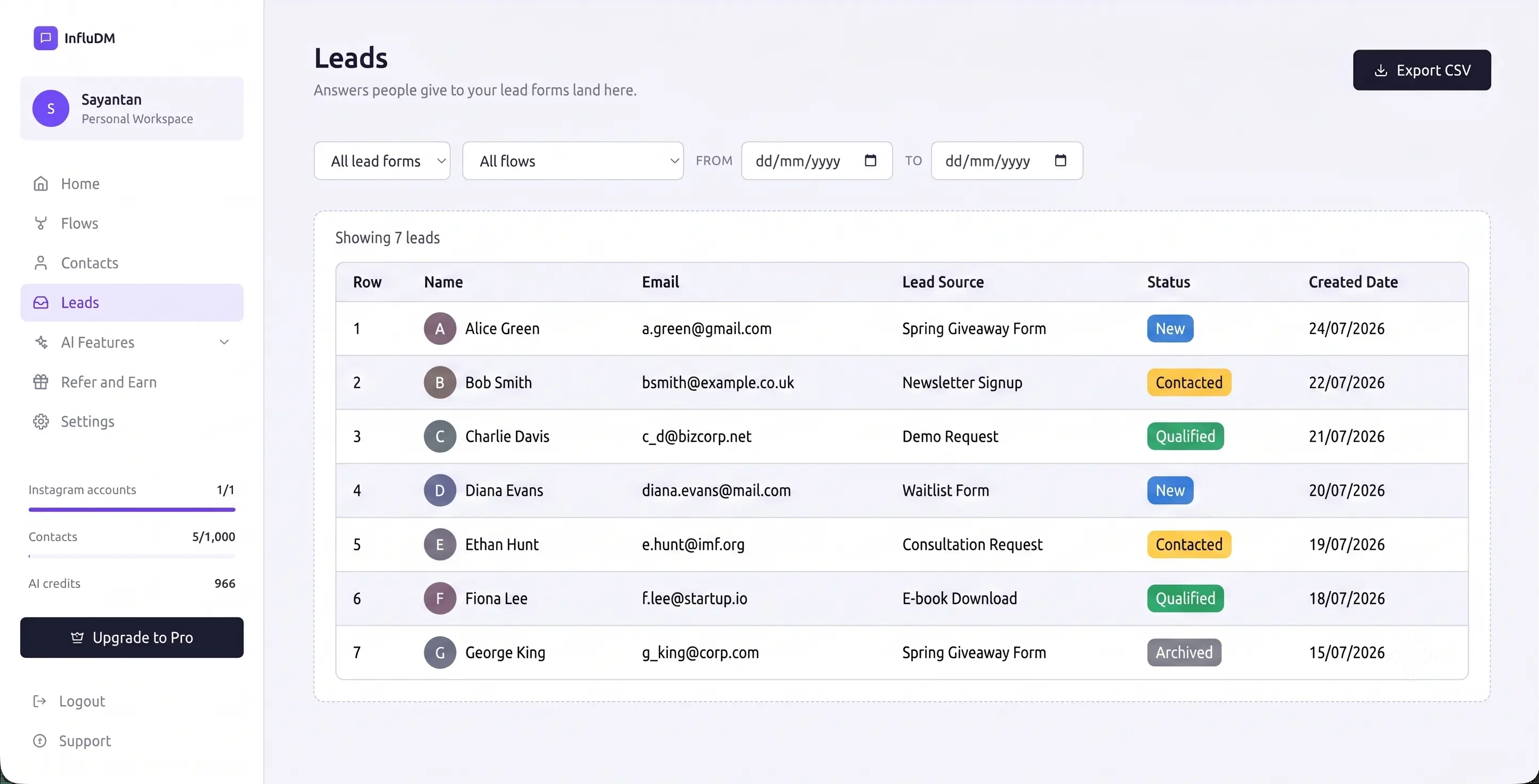 The Leads table with its lead form, flow and date filters above it, and Export CSV at the top right.
Filters
| Filter | What it narrows to |
|---|---|
| Lead form | Submissions of one form. |
| Flow | Submissions captured by one flow. |
| Account | One Instagram account (shown only when several are connected). |
| From / To | A date range. |
Filter options are built from what exists today. A lead whose flow was since deleted still shows the flow's name in the row — it just can't be filtered to any more.
Exporting to CSV
Export CSV downloads the current filtered set as leads-YYYY-MM-DD.csv. Filters apply to the export, so narrow first and you get exactly the segment you wanted.
Very large exports come back in date-range slices — narrow the dates and export twice.
Why leads outlive everything else
Captured leads are your data, and they're deliberately hard to lose. Each submission stores a snapshot of:
- the contact's username and name,
- the Instagram account's username,
- the flow's name,
- the lead form's name,
- every question prompt, field type and answer.
So a lead stays complete and readable after the flow is deleted, the form is deleted, or the Instagram account is disconnected. Only deleting the workspace destroys them.
Leads on a contact
The Contacts table has a Leads column. Where a contact has submissions, the count is a button that opens their answers in place — useful when you're looking at one person rather than one form.
What isn't here
- Abandoned forms. Someone who answered two of four questions has no lead row. Their partial answers are held against the conversation, not surfaced as a lead.
- Skipped fields. These are recorded as part of the submission, shown blank.